Jack Store blog · Walk & Training
Puppy Potty Training: Schedules, Signals and Common Mistakes
Last updated:
As an Amazon Associate we earn from qualifying purchases.
A puppy potty training schedule starts with one number: a puppy can generally hold its bladder for about as many hours as its age in months, according to the American Kennel Club (AKC). That is the ceiling, not the plan. While the puppy is awake, expect a trip outside every one to two hours, plus one after every nap, meal, drink and play session.
Below: the schedule by age from 8 weeks to 6 months, the moments that override the clock, a sample day, the night routine and what to do when an accident happens anyway. The numbers come from the AKC and Humane World for Animals.
In this guide
- How often should a puppy go out? The schedule by age
- The moments that override the clock
- A sample day for a 10-week-old puppy
- Signals that mean your puppy needs to go now
- At the potty spot: one place, one cue, one reward
- Night potty training: dinner, water and the last trip
- Between trips: crate, pen or leash
- Accidents: what to do in the moment, and after
- Common potty training mistakes, and the fix for each
- The honest catch
- Frequently asked questions
How often should a puppy go out? The schedule by age
Two AKC rules frame the chart. Its house-training guide says puppies can generally hold their bladder for approximately the same number of hours as their age in months, up to about 9 months to 1 year of age. Its potty training timeline gives a looser version for crate time, the month-plus-one rule: age in months plus one is the maximum number of hours between potty breaks.
Plan with the first number and treat the second as the outer limit. Neither describes an awake, playing puppy, which needs to go far more often: every one to two hours during waking periods (AKC), and again around play: the AKC’s timeline notes that the stimulation of playtime may give a puppy the urge to go.
The awake column below is our planning figure, set inside that one-to-two-hour range and tightened for the youngest puppies; the night column is ours too. It is a starting point, not a clinical chart: the AKC notes that individual puppies vary, so if accidents happen before the interval is up, shorten it.
| Age | While awake, go out | Longest stretch to plan for | Night |
|---|---|---|---|
| 8 weeks (about 2 months) | Every hour | About 2 hours | Outings may be needed |
| 10 weeks | Every hour | Between 2 and 3 hours | Outings may be needed |
| 12 weeks (about 3 months) | Every 1 to 2 hours | About 3 hours | Outings may be needed |
| 16 weeks (about 4 months) | Every 2 hours | About 4 hours | Outings may be needed |
| 5 months | Every 2 hours, longer as clean days add up | About 5 hours | Often sleeps through |
| 6 months | Every 2 hours, longer as clean days add up | About 6 hours | Often sleeps through |
The moments that override the clock
The interval is the backstop. Most successful trips are set off by an event, not by the timer.
Of the triggers below, meals are the one you control. The AKC notes that most growing puppies eat three to four meals a day and that most will need to poop after each one. Feed at the same times every day, as Humane World recommends, and the hardest trips become the most predictable ones.
- First thing in the morning and last thing at night.
- The moment a nap ends.
- After a meal: the AKC says to wait only between 5 and 30 minutes, and the younger the puppy, the sooner.
- After a big drink of water. Treat it like a meal.
- After play, and mid-play if the puppy wanders off or starts to sniff (AKC).
- After time in the crate, and after a long chew on a toy or bone.
A sample day for a 10-week-old puppy
Here is how the clock and the triggers combine in a house that wakes at 6:30 a.m. The times are an example; the order is the point.
Count the trips in the list below and you land on the AKC’s own estimate: a young puppy may need to go outside a dozen times or more each day. The naps in this plan are laid out hour by hour in our puppy crate training schedule.
- 6:30 a.m. Out of the crate and straight outside, carried if the puppy is small enough.
- 6:45 a.m. Breakfast, then back outside by 7:15.
- 7:30 a.m. Play, and outside again when play ends.
- 8:00 a.m. Nap. Outside the moment the puppy wakes.
- Rest of the morning: awake means a trip every hour; asleep means a trip on waking.
- 12:00 p.m. Lunch, outside within 30 minutes, then the same loop all afternoon.
- 5:30 p.m. Dinner, and outside within 30 minutes.
- 7:30 p.m. Water dish up, for a 10:00 p.m. bedtime.
- 9:55 p.m. Last trip, then bed.
Signals that mean your puppy needs to go now
Puppies announce it. The announcement is just easy to miss. The AKC and Humane World describe the same short list, below.
When you see any of them, skip the debate and go: take the puppy to its potty spot immediately, as both the AKC and Humane World advise. A false alarm costs two minutes; a missed signal costs a puddle.
- Sniffing the floor or the carpet
- Circling
- Stopping play suddenly, or wandering away from the family
- Restlessness, whimpering or a sudden burst of zoomies
- Running to the door, or scratching at it
At the potty spot: one place, one cue, one reward
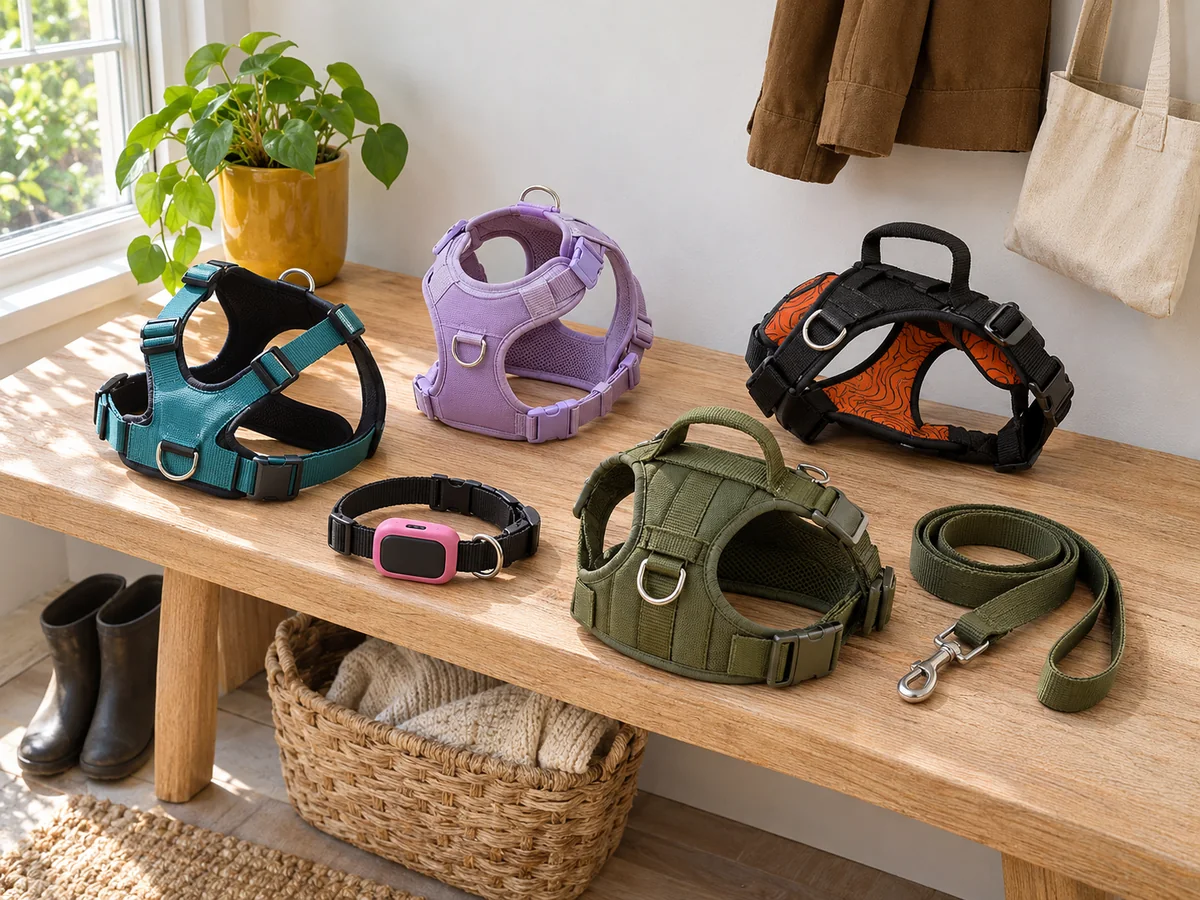
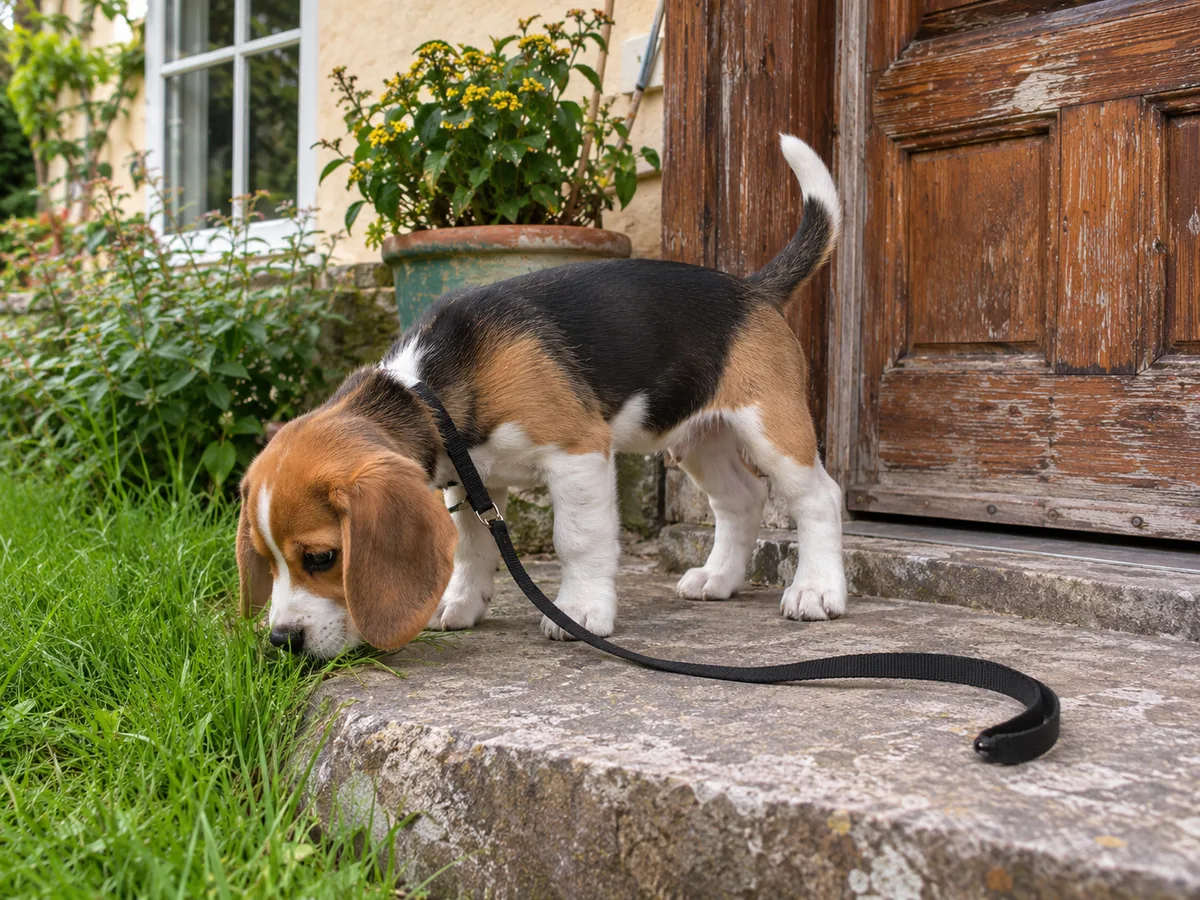
Pick one spot and walk the puppy there on a leash every time, even in your own yard; Humane World’s line is to treat the yard like any other room in the house. Any light puppy harness from our Walk and Training picks will do. Stand quietly. As the puppy starts, say your cue once (“go potty” works) so the words attach to the act.
Reward at the spot, not back in the kitchen. Humane World’s tip is to wait until the puppy is completely finished, because puppies are easily distracted and may stop midway if interrupted. Then stay out for a bit: the AKC suggests playing for a few minutes before rushing back inside. Our read on why it helps: a puppy that learns the fun ends the instant it pees will start to stall.
If nothing happens, the AKC’s advice is to go in and come back out again in a few minutes. Clip a bag holder to the leash from day one; the one in our catalog is the VETRESKA dispenser.
Night potty training: dinner, water and the last trip
Nights are easier than days for a physical reason: the AKC notes that puppies can usually hold their bladder for a longer period when they are asleep and not active. Humane World says most puppies can comfortably sleep for seven hours without a bathroom break. Most is not all: the AKC’s advice is to keep the crate close enough to hear a whimper if the puppy needs to go out during the night.
One note on the routine below: picking up the water dish is an evening habit, not a reason to ration water during the day.
- Dinner early: the AKC advises against feeding within 2 hours of bedtime.
- Water dish up about two and a half hours before bedtime (Humane World).
- The last trip is the last thing you do before bed.
- Crate in or near your bedroom, so you hear a whimper (AKC).
- If the puppy wakes you: out quietly, potty, back to bed. No playtime.
Between trips: crate, pen or leash
A puppy with the run of the house will find a quiet corner. Until the habit is solid, the puppy is always in one of three places: outside with you, under your eyes, or in a space small enough that it will not want to soil it.
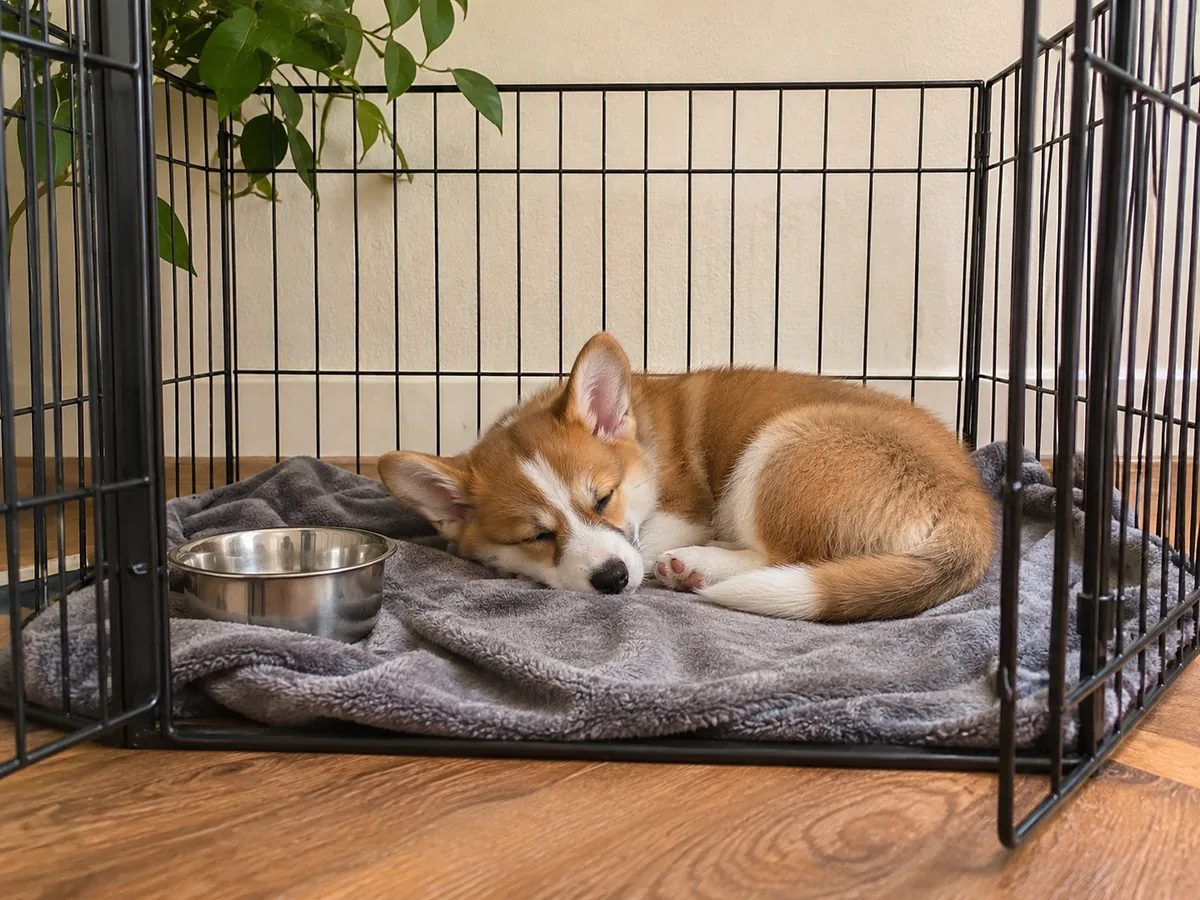
Under your eyes can mean attached: Humane World suggests tethering the puppy to you or to nearby furniture with a 6-foot leash when you are not actively playing or training. When you cannot watch, use a crate or a gated area. The AKC’s size rule for the crate: large enough to stand, turn around and lie down comfortably, but not so large that the puppy can go potty in one corner and rest in another. For how long, go back to the month-plus-one rule above, the AKC’s ceiling for crate time.
The crates and playpens we would pick for this stage are in our Sleep and Home picks.
Accidents: what to do in the moment, and after
Catch the puppy mid-squat and your only job is to interrupt and relocate. The AKC suggests a noise or an “uh-oh” to get its attention, then picking the puppy up, taking it outside and praising when it finishes there.
Find a puddle after the fact and there is nothing left to teach. Both sources say the same thing: do not punish. Humane World warns that scolding a puppy or rubbing its nose in the mess will only make it fearful and slow progress. Our reading of what fearful looks like: the puppy that will not pee on the leash in front of you and slips behind the couch instead.
Then clean it properly: the AKC says dogs frequently return to areas that still smell like previous accidents, and advises keeping an enzymatic pet stain cleaner on hand for exactly this.
Common potty training mistakes, and the fix for each
Most stalled house-training comes down to one of six habits, and all six belong to the owner, not the puppy.
| Mistake | Fix |
|---|---|
| Stretching the interval after one good day | Hold each interval until clean days add up; drop back a step after an accident |
| Giving the puppy the run of the house | Crate, pen or leash. The AKC says gradually increasing freedom works better than unrestricted access too early |
| Handing over the treat back indoors | Reward at the spot, as soon as the puppy finishes |
| Hurrying inside the moment it pees | Stay and play for a few minutes first |
| Scolding a puddle you found later | Clean it calmly and supervise more closely |
| Assuming every accident is behavior | No progress despite a consistent routine: see the vet |
Frequently asked questions
How often should I take an 8-week-old puppy out to pee?
About every hour while the puppy is awake, plus right after every nap, meal, drink and play session. The AKC’s rule of thumb gives a 2-month-old about two hours of bladder control at most. Expect a dozen or more trips a day at this age.
How long after eating does a puppy need to poop?
Soon. The AKC says to wait only between 5 and 30 minutes after a meal before taking a puppy outside, and the younger the puppy, the sooner. Most growing puppies eat three to four meals a day, so fixed mealtimes give you three or four trips you can see coming.
Can a puppy hold it all night?
Often longer than by day: the AKC notes that puppies can usually hold their bladder for a longer period when asleep and not active. Humane World says most puppies can comfortably sleep for seven hours without a bathroom break. A young puppy may still need a trip, so keep the crate within earshot.
Are puppy pads a good idea?
They are a trade-off. The AKC says pads can be useful for owners who cannot get home often and for very small dogs in severe weather, but they can sometimes slow the transition to going outdoors, because the puppy learns two approved places. If outdoors is the goal and your schedule allows it, skip them.

Sources
Nothing on this site is veterinary advice. Health claims belong to the manufacturer; your vet knows your dog.

By Jack ReyesJack Reyes writes and edits the guides and picks on jackstore.fun, and reads the fine print on dog gear so you do not have to: how a thing works, who it is for and who should skip it. Jack Reyes does not test products and never quotes prices. The other Jack, the Maltipoo on our logo, is the site mascot.