Jack Store blog · Sleep & Home
What Size Dog Crate Do I Need? Crate Size Chart by Weight and Breed
Last updated:
As an Amazon Associate we earn from qualifying purchases.
A dog crate size chart is only as good as the two numbers you bring to it: your dog’s height and length. The rule the sources agree on is that a dog should be able to stand up, turn around and lie down comfortably, with little room to spare. Weight and breed get you to a row; the measurements confirm it.
Below is a full chart from a crate maker’s official guide, covering eight crate lengths from 18 to 54 inches, then how to measure, what to do when weight and breed point to different rows, and how to size a crate for a puppy that is still growing. Where the sources disagree, we say so.
In this guide
- Dog crate size chart by weight, height and breed
- What size crate for a Labrador, Golden Retriever, German Shepherd or French Bulldog?
- How to measure your dog for a crate
- When weight and breed point to different rows
- Sizing a crate for a puppy: buy for the adult, shrink with a divider
- Can a crate be too big? Too small?
- Wire, plastic, furniture or soft crate: does the type change the size?
- The honest catch
- Frequently asked questions
Dog crate size chart by weight, height and breed
The chart is MidWest Homes for Pets’ own, from its crate sizing guide. We use it because it gives the dog’s maximum height and length next to the weight, and because wire crates sold by length (24, 30, 36, 42 inches and so on) are a common format. The numbers are MidWest’s and describe its crates. Another brand’s 36-inch crate can carry a different weight range, so always read the chart on the listing you buy from.
Crate length is the name of the size. The columns that decide the fit are the two in the middle: the tallest and the longest dog MidWest puts in each crate.
| Crate length | Dog weight | Max. dog height | Max. dog length | Breeds MidWest lists |
|---|---|---|---|---|
| 18 in (Tiny) | 1 to 6 lbs | 12 in | 17 in | Jack Russell Terrier, Pomeranian, Maltese |
| 22 in (XS) | 7 to 11 lbs | 14 in | 20 in | Papillon, Yorkshire Terrier, Japanese Chin |
| 24 in (Small) | 12 to 20 lbs | 18 in | 22 in | Boston Terrier, Chihuahua, Pug, Miniature Poodle |
| 30 in (Medium) | 21 to 40 lbs | 20 in | 30 in | Dachshund, Pekingese, Shetland Sheepdog, French Bulldog |
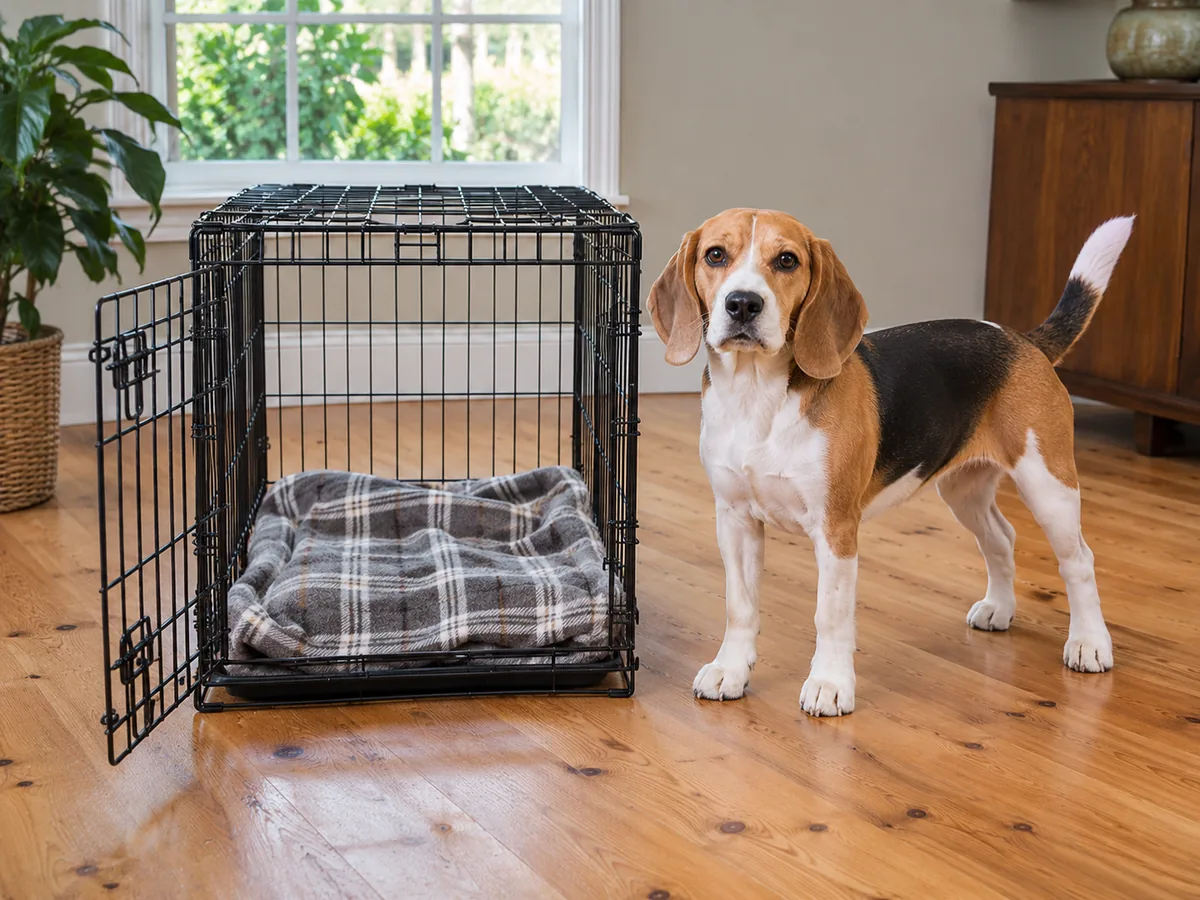
| 36 in (Intermediate) | 41 to 70 lbs | 23 in | 34 in | Basset Hound, Whippet, Beagle, Bulldog, Brittany Spaniel |
| 42 in (Large) | 71 to 90 lbs | 28 in | 40 in | Australian Shepherd, Boxer, Border Collie, Chow Chow, Labrador Retriever |
| 48 in (XL) | 91 to 110 lbs | 30 in | 46 in | Collie, Greyhound, Rottweiler, German Shepherd, Siberian Husky |
| 54 in (XXL) | 110 lbs and up | 36 in | 54 in | Great Dane, Mastiff, St. Bernard, Irish Wolfhound |
What size crate for a Labrador, Golden Retriever, German Shepherd or French Bulldog?
MidWest also publishes a longer size and breed reference that places more than a hundred breeds. The list below pulls out the ones people ask about most, by crate length.
The sheet carries a caveat worth reading first: depending on the gender and the possibility of mixed ancestry, your dog may need a home that is larger or smaller than listed. A breed name is a starting row, not a verdict.
- 18 or 22 in: Maltese, Pomeranian, Papillon, Yorkshire Terrier
- 24 in: Boston Terrier, Chihuahua, Miniature Dachshund, Miniature Poodle, Pug, Shih Tzu, West Highland Terrier
- 30 in: Cairn Terrier, Dachshund, French Bulldog, Miniature Schnauzer, Shetland Sheepdog
- 36 in: Beagle, Bulldog, Cocker Spaniel, Welsh Corgi, Australian Cattle Dog, Whippet
- 42 in: Labrador Retriever, Golden Retriever, Boxer, Border Collie, Australian Shepherd, Standard Poodle
- 48 in: German Shepherd, Rottweiler, Doberman Pinscher, Siberian Husky, Bernese Mountain Dog
- 54 in: Great Dane, Mastiff, St. Bernard, Irish Wolfhound, Great Pyrenees
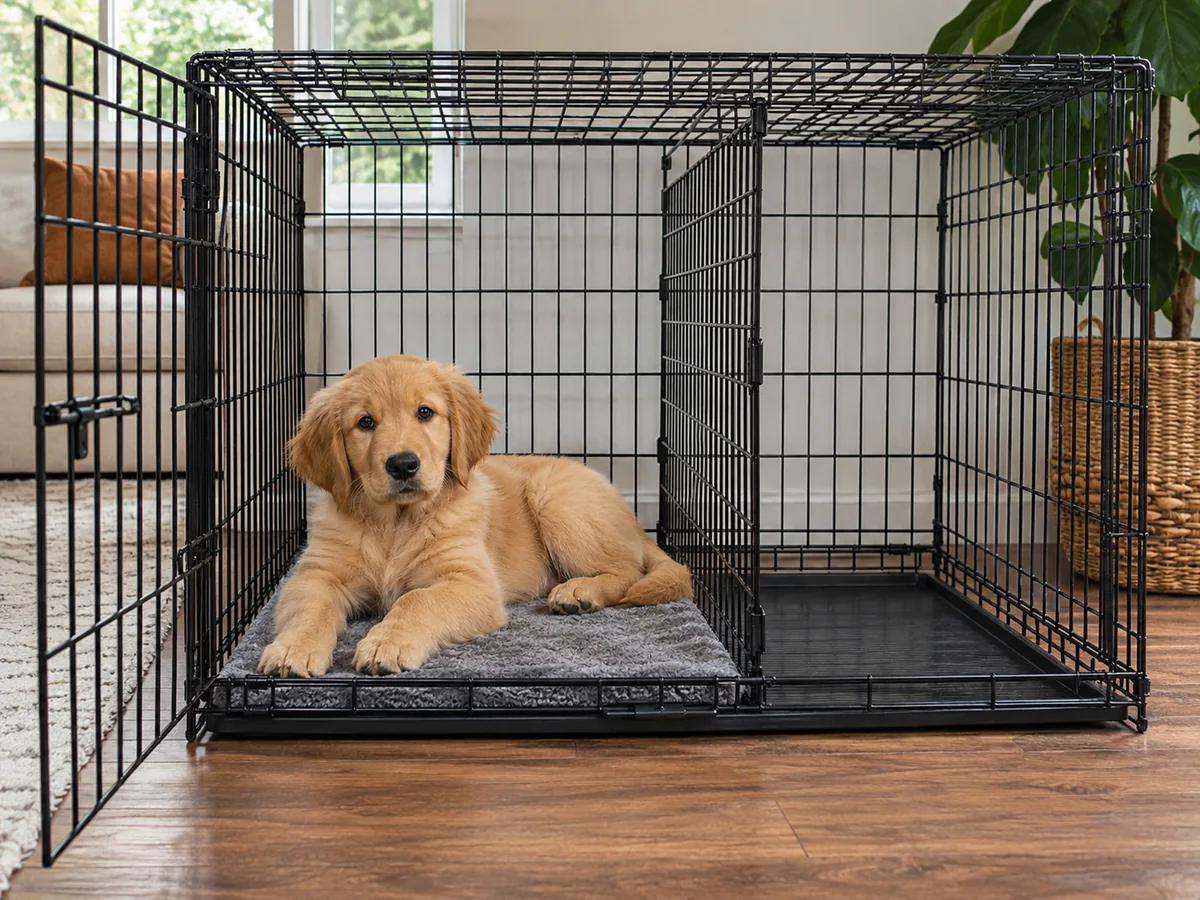
How to measure your dog for a crate
You need two measurements, both taken with the dog standing. MidWest’s tip for a wiggly dog is to keep plenty of treats on hand so it holds still.
The two methods in the list below are not the same, and the gap matters for dogs with long tails. The AKC’s crate guide measures from the tip of the nose to the tip of the tail and adds 3 to 4 inches. MidWest measures to the base of the tail and adds a few inches. On a long-tailed dog, the two methods can land in different rows.
Our reading: when you are using a maker’s chart, measure the maker’s way, because its columns were built on that method. When the crate you are considering has no chart, use the AKC’s method, which gives you real numbers to compare with the interior height and length on the listing.
- Height: from the top of the head to the floor, with the dog standing upright.
- Length: from the tip of the nose to the tail. The AKC measures to the tip of the tail; MidWest measures to the base.
- Add room: the AKC says to add 3 to 4 inches to each measurement; MidWest says a few inches.
- Match the result to the chart for the crate you are buying. If your dog passes either maximum in a row, move to the next row.
When weight and breed point to different rows
Read MidWest’s chart closely and the breed column runs larger than the weight column. Beagle sits in the 36-inch row, labeled 41 to 70 pounds; the AKC’s breed page lists Beagles at under 20 pounds or 20 to 30 pounds, depending on the height variety. Chihuahua sits in the 24-inch row, labeled 12 to 20 pounds; the AKC gives the Chihuahua’s weight as not exceeding 6 pounds.
So a 25-pound Beagle is a 30-inch dog by weight and a 36-inch dog by breed, on the same chart. Neither column is wrong so much as rough. One sorts by mass; the other, as we read it, by a typical body with room to stretch. The tiebreaker is your own measurement: check your dog’s height and length against the two maximum columns and take the smallest crate that clears both.
For mixed breeds, MidWest’s advice is to make an educated guess from the size of the parents if you know them, and to ask your rescue or veterinarian to help identify the likely breeds if you do not.
Sizing a crate for a puppy: buy for the adult, shrink with a divider
A puppy needs a crate that fits today, and it will not be the same puppy in a month. The AKC, MidWest and Humane World for Animals agree on the first half of the answer: choose the crate for the dog’s expected adult size. The second half is making it smaller for now. For a purebred, MidWest suggests looking up the adult size of the breed and keeping in mind the difference between males and females.
The tool is a divider panel. The AKC describes crates with a divider you adjust to expand the space as the puppy grows. MidWest adds two practical details: move the panel gradually, leaving just enough room to stand, turn around and lie down, and fit it snug across the width of the crate, not the length. Not every crate includes one. The MidWest iCrate starter kit in our catalog is a 24-inch crate, the Small row above; confirm on the listing that a divider comes with it.
No divider? Humane World offers another route: some animal shelters rent out crates, so you can trade up in size until the puppy is grown and then buy the permanent one. Once the size is settled, our puppy crate training schedule covers what to do with the crate hour by hour, and the puppy potty training schedule shows where the small space fits into house-training.
Can a crate be too big? Too small?
Both, and they fail in different ways. Too large, and house-training suffers: the AKC warns that an oversized crate could encourage a dog to eliminate inside it, because the dog can sit away from the mess. MidWest adds that a crate that is too large may take away the sense of security a crate should give.
Too small is a comfort problem. MidWest describes it as confining and uncomfortable, a source of stress and even physical discomfort. Humane World’s floor is that the dog can stand up and turn around. If your adult dog has to duck to stand, or cannot lie down comfortably, the crate is too small, whatever the label says.
Wire, plastic, furniture or soft crate: does the type change the size?
The rule stays the same; where you find the numbers changes. Wire crates are named by length, which is why the chart works for them. For the other types the AKC describes (plastic crates, wooden furniture crates and fabric crates), go by the interior dimensions and the weight guidance on the listing.
Brands do not agree row for row. The Petmate Pet Porter in our catalog is a 24-inch plastic kennel listed for pets of 15 to 20 pounds; MidWest’s 24-inch wire row says 12 to 20. Furniture crates need the closest reading, because the inside is smaller than the footprint suggests. The crates we would choose from are on our Sleep and Home page.
Flying is a separate question. The AKC’s note for flyers is to choose a plastic crate that is airline-approved. What that means is set by the carrier, so ask the airline before you buy a crate for a flight.
Frequently asked questions
What size crate does a Labrador Retriever need?
MidWest’s chart and its longer breed reference both place the Labrador Retriever in a 42-inch crate, the row labeled for dogs of 71 to 90 pounds, up to 28 inches tall and 40 inches long. Individual dogs vary, so check yours against the height and length columns before you order.
Should a dog be able to stand up in its crate?
Yes. The AKC says a dog needs enough room to sit, stand and lie down comfortably, and Humane World for Animals says the crate should be large enough for the dog to stand up and turn around in. To get there, the AKC adds 3 to 4 inches to the dog’s standing height and length.
Is it better for a crate to be too big or too small?
Neither. Too small is uncomfortable for the dog, and too big works against house-training: the AKC warns that an oversized crate can encourage a dog to eliminate inside it and sit away from the mess. For a growing puppy, buy the adult size and block off the extra space with a divider panel.
What size crate should I get for a puppy?
Buy for the adult dog. The AKC, MidWest and Humane World for Animals all recommend a crate that fits the expected adult size. The AKC and MidWest pair it with a divider panel that shrinks the space while the puppy grows, moved gradually so there is always just enough room to stand, turn around and lie down.

Sources
- MidWest Homes for Pets: What Size Crate Should I Get?
- MidWest Homes for Pets: Dog Crate Size and Breed Reference (PDF)
- AKC: Crates for Dogs, How to Choose the Best Dog Crate
- Humane World for Animals: How to Crate Train Your Dog or Puppy
- AKC: Beagle Dog Breed Information
- AKC: Chihuahua Dog Breed Information
Nothing on this site is veterinary advice. Health claims belong to the manufacturer; your vet knows your dog.

By Jack ReyesJack Reyes writes and edits the guides and picks on jackstore.fun, and reads the fine print on dog gear so you do not have to: how a thing works, who it is for and who should skip it. Jack Reyes does not test products and never quotes prices. The other Jack, the Maltipoo on our logo, is the site mascot.