Jack Store blog · Walk & Training
Front-Clip vs Back-Clip Harness: Which One Actually Stops Pulling?
Last updated:
As an Amazon Associate we earn from qualifying purchases.
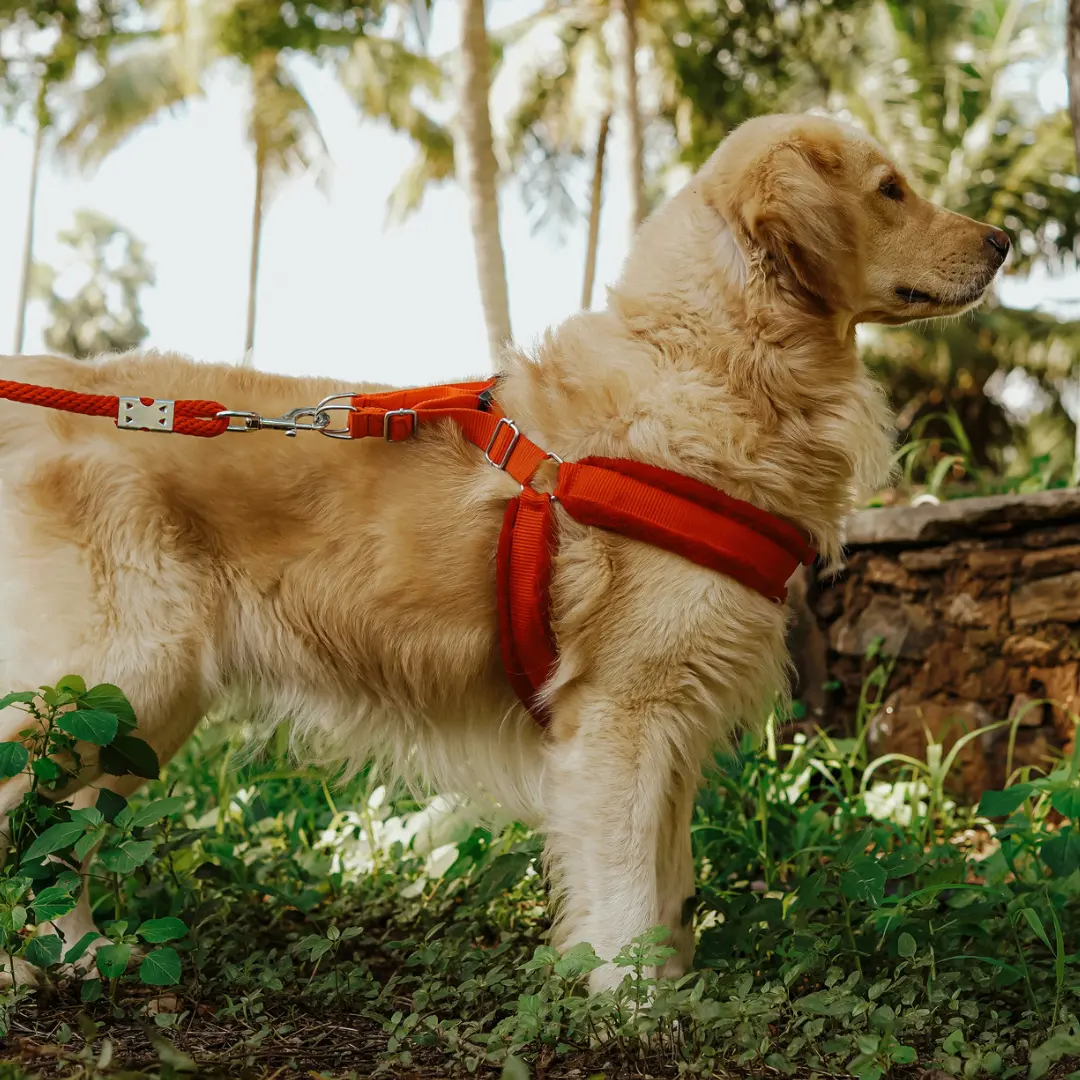
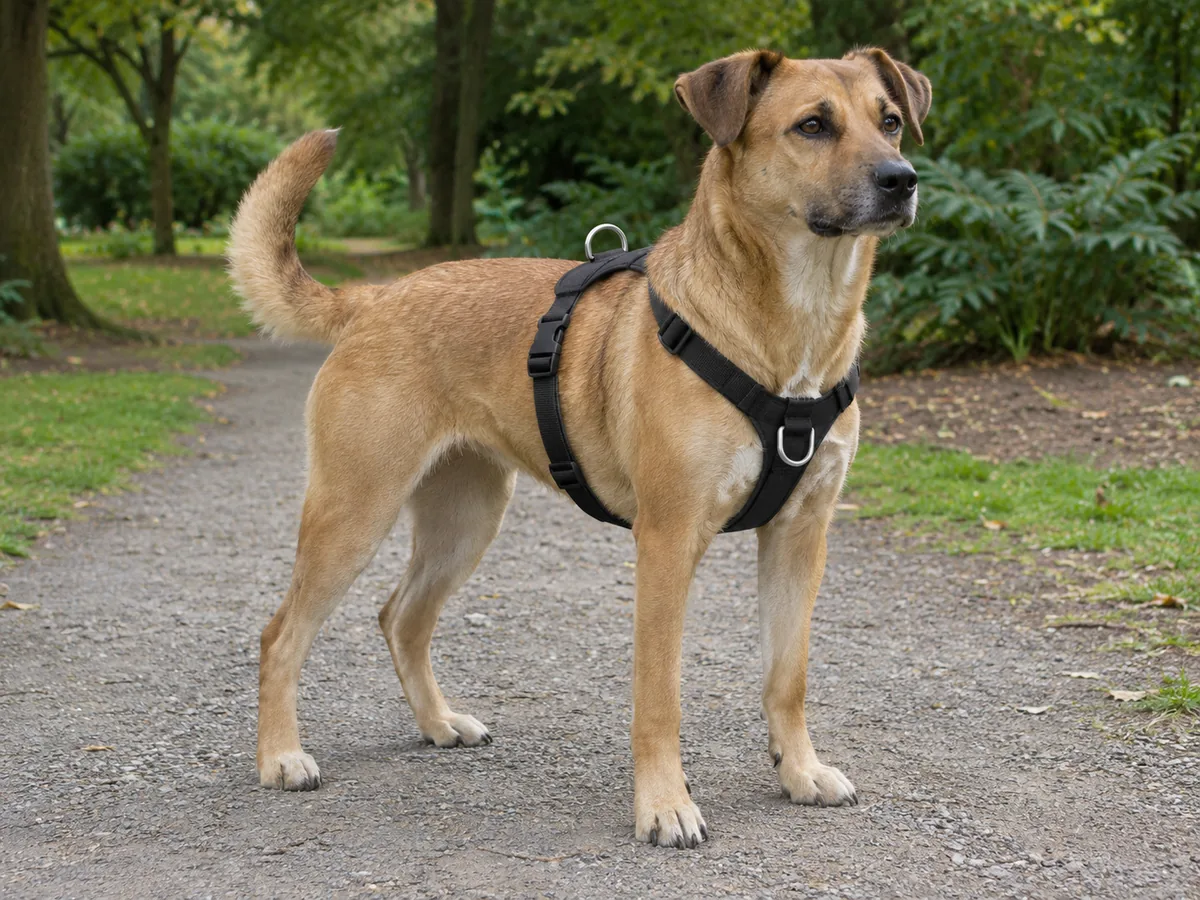
The front clip vs back clip harness question has a short answer: clip to the front if your dog pulls, to the back if it does not. A front clip sits at the chest, so when the dog surges, the leash turns it sideways toward you instead of letting it lean in. A back clip sits between the shoulder blades, is easier to live with and suits a dog that already walks on a loose leash.
Neither one stops pulling by itself. The American Kennel Club (AKC) says only that a front attachment helps redirect a dog’s movement and may discourage pulling. The table below matches the clip to the dog and the situation; the sections after it cover shoulders, necks, dual-clip harnesses and the limits of all of it.
In this guide
- Front clip or back clip: the decision table
- How a front-clip harness changes a pull
- What a back clip does better
- Does a front-clip harness actually stop pulling?
- Are front-clip harnesses bad for a dog's shoulders?
- Why either clip beats a collar for a dog that pulls
- Dual-clip harnesses: start at the front, graduate to the back
- Fit decides whether the clip works
- The honest catch
- Frequently asked questions
Front clip or back clip: the decision table
Find your dog in the left column. Where a row names a source, the reasoning is theirs; putting the rows side by side is ours. AKC rows come from its harness guide and its collar comparison; the rows marked ours are our reading of the same guidance.
| Your dog or situation | Clip | Why |
|---|---|---|
| Pulls on most walks | Front | Helps redirect forward movement and may discourage pulling; attached at the front of the body, the harness gives you leverage (AKC) |
| Already walks on a loose leash | Back | The veterinarian quoted by the AKC recommends back-clip harnesses for well-trained dogs: easy to clip on and go |
| Still learning the leash | Dual clip, front first | Start with the front clip for added control, switch to the back as the dog becomes reliable (AKC) |
| Small dog that does not pull | Back | A back attachment is a popular choice for small dogs and makes it less likely the leash gets caught under the legs (AKC) |
| Bulldog, French Bulldog or Pug | Either, on a harness | The veterinarian quoted by the AKC recommends harnesses for these breeds: with necks nearly as wide as their heads, they slip out of collars more easily |
| Dog is larger or stronger than the walker | Front, no-pull style | The veterinarian quoted by the AKC calls no-pull harnesses helpful for dogs larger than the person walking them, a person wheeling a stroller or someone with a mobility issue |
| Hiking, dog out ahead on a loose leash | Back | Ours: with no pulling to redirect, the easy clip wins, and the AKC notes a back attachment makes it less likely the leash gets caught under the legs |
| Strong dog on a dual-clip harness | Both at once | Ours: a double-ended leash on both rings gives two points of contact. The sources we cite do not cover this setup |
How a front-clip harness changes a pull
A dog pulls because pulling works: lean forward, reach the smell sooner. A back clip leaves that deal intact. The leash pulls straight back along the spine and the dog can put its whole chest into the harness. The AKC’s advice points the same way: the veterinarian it quotes recommends back-clip harnesses for well-trained dogs, not for pullers.
Move the leash to the chest and the geometry changes. Now a surge swings the dog’s front end around toward you. The AKC describes the effect two ways: the front attachment helps redirect the dog’s movement, and it gives you leverage. Forward stops paying, and you get a second of slack leash to reward.
Some no-pull models add one more thing. The AKC describes harnesses with a front-mounted D-ring that, in the words of veterinarian Dr. Amy Attas, will constrict the harness a little bit when the dog starts to pull. That is a different mechanism from a plain front ring. If it matters to you, look for the words martingale or tightening on the listing before you buy.
What a back clip does better
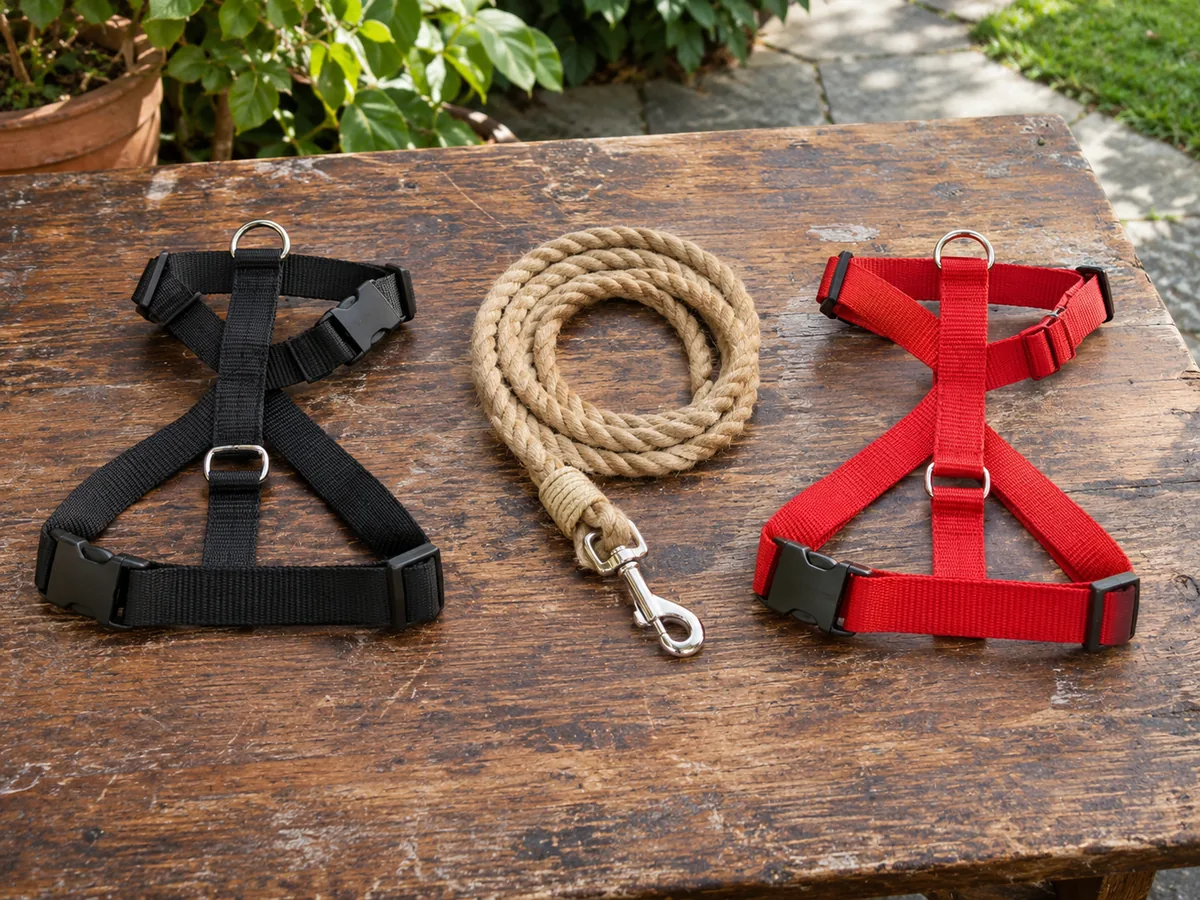
A back clip is the low-maintenance choice. The ring sits between the shoulder blades, which the AKC describes as easy to clip on the leash and go, and the leash stays up and away from the front legs. The front position has the opposite trade-off: the AKC notes that a clip near the chest makes attaching the leash less convenient.
For small dogs the case is stronger. The AKC calls a body harness with a back attachment a popular choice for small dogs, because it can prevent potential throat damage if the dog pulls and makes it less likely that the leash will get caught under the legs.
A back-clip harness is also a gentle first harness: light, simple, one ring. The Red Dingo Classic in our catalog is that kind of starter. It is back-clip only, so it protects the neck while manners form and does nothing to redirect a pull.
Does a front-clip harness actually stop pulling?
It reduces pulling while the harness is on. It does not teach a dog to walk next to you. Read the verbs the AKC chooses: helps redirect, may discourage, gives you leverage. Nobody credible writes cured.
What the front clip buys you is leverage and a training window. Each time the dog turns back and the leash goes slack, reward it at your knee and walk on. A dog that only ever gets redirected can learn a workaround: pulling forward at an angle. Our no-pull harness guide ends with the short loose-leash routine that makes the clip worth having, next to the harnesses we would pick.
Are front-clip harnesses bad for a dog’s shoulders?
It depends on where the straps sit, not on where the ring is. The AKC’s fit advice names the thing to check: make sure the harness does not interfere with shoulder or leg movement, and watch for rubbing, pressure points or skin irritation. A strap that lies across the point of the shoulder is the obvious way to fail that check. That reading is ours; the AKC’s guide does not single out front-clip designs.
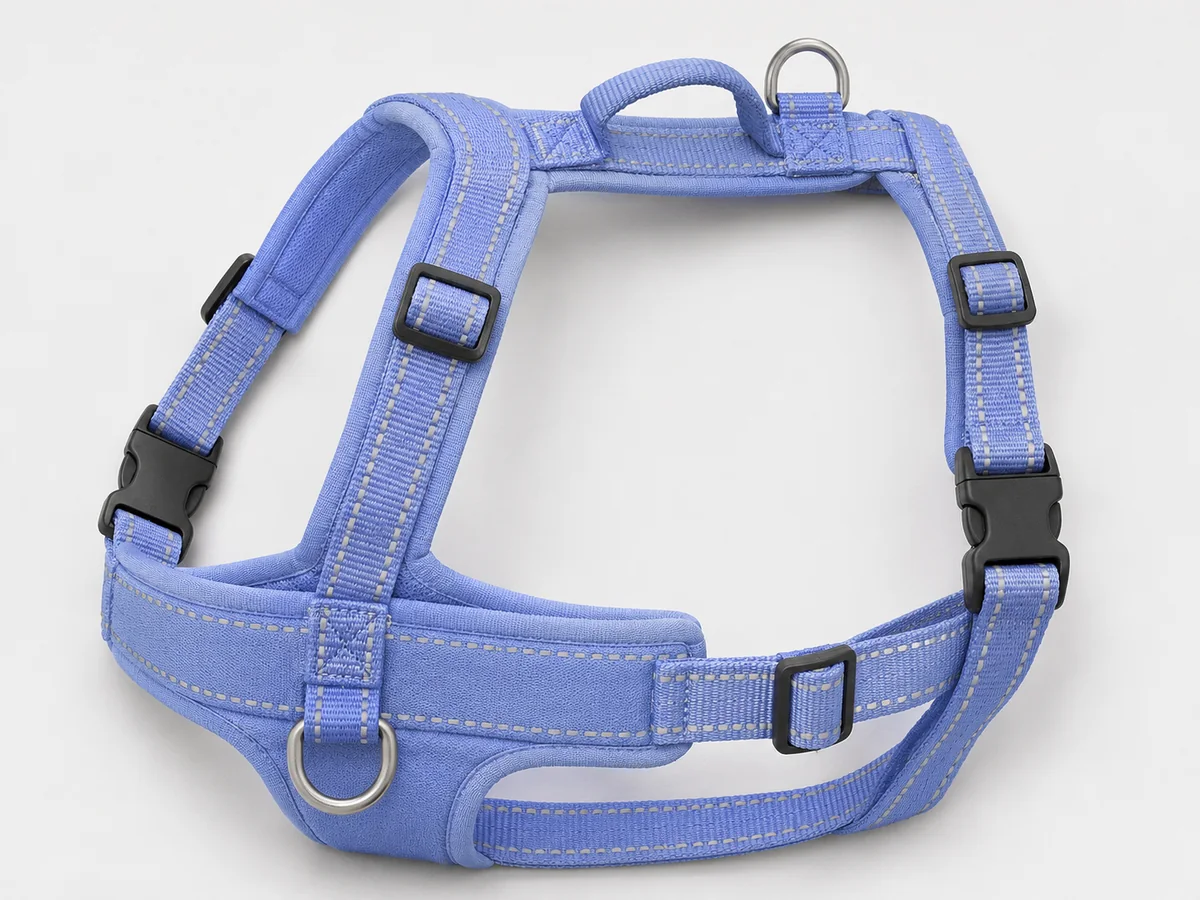
So look at the chest piece from the front. A Y shape that runs down the breastbone leaves the points of the shoulders open. A strap that runs straight across the chest is the design to check twice: fitted low or loose, it can end up over the joints. The Blue-9 Balance is the Y-front example in our catalog, with six points of adjustment.
The research is thinner than the opinions. A 2019 study from the Royal Veterinary College filmed nine dogs on a treadmill and concluded that harnesses do limit shoulder extension. Against expectations, extension was reduced more under the harness classed as non-restrictive than under the restrictive one. Nine dogs is a small sample, and the study measured stride at a walk and a trot, not long-term joint health. The fair reading: any harness changes the stride a little, so fit it carefully and watch how your dog moves instead of trusting a label.
Why either clip beats a collar for a dog that pulls
The front-or-back debate sits inside a bigger one that is mostly settled. The AKC says a harness puts less pressure on a dog’s neck than a traditional collar does, helps distribute pressure around the chest and shoulders, and can help reduce the risk of neck strain or injury in dogs that pull. It adds that harnesses can also help dogs with neck pain, breathing problems or heart disease.
There is a measurement behind it. A University of Wisconsin-Madison study of 26 dogs found that pressure inside the eye increased significantly from baseline when neck pressure was applied with a collar, but not with a harness. The authors concluded that dogs with glaucoma, weak or thin corneas, or other conditions where that increase could be harmful should wear a harness instead of a collar.
If your dog has an eye, airway or neck condition, the gear is a question for your vet, not for a blog. For everyone else: keep the flat collar for the ID tags and clip the leash to the harness.
Dual-clip harnesses: start at the front, graduate to the back
If you are unsure, buy both rings. The AKC describes dual-clip harnesses as nice for teaching a dog to use a harness: start with the front clip for added control, then switch to the back clip as the dog becomes more comfortable and reliable on walks. One harness covers the training months and the years after them.
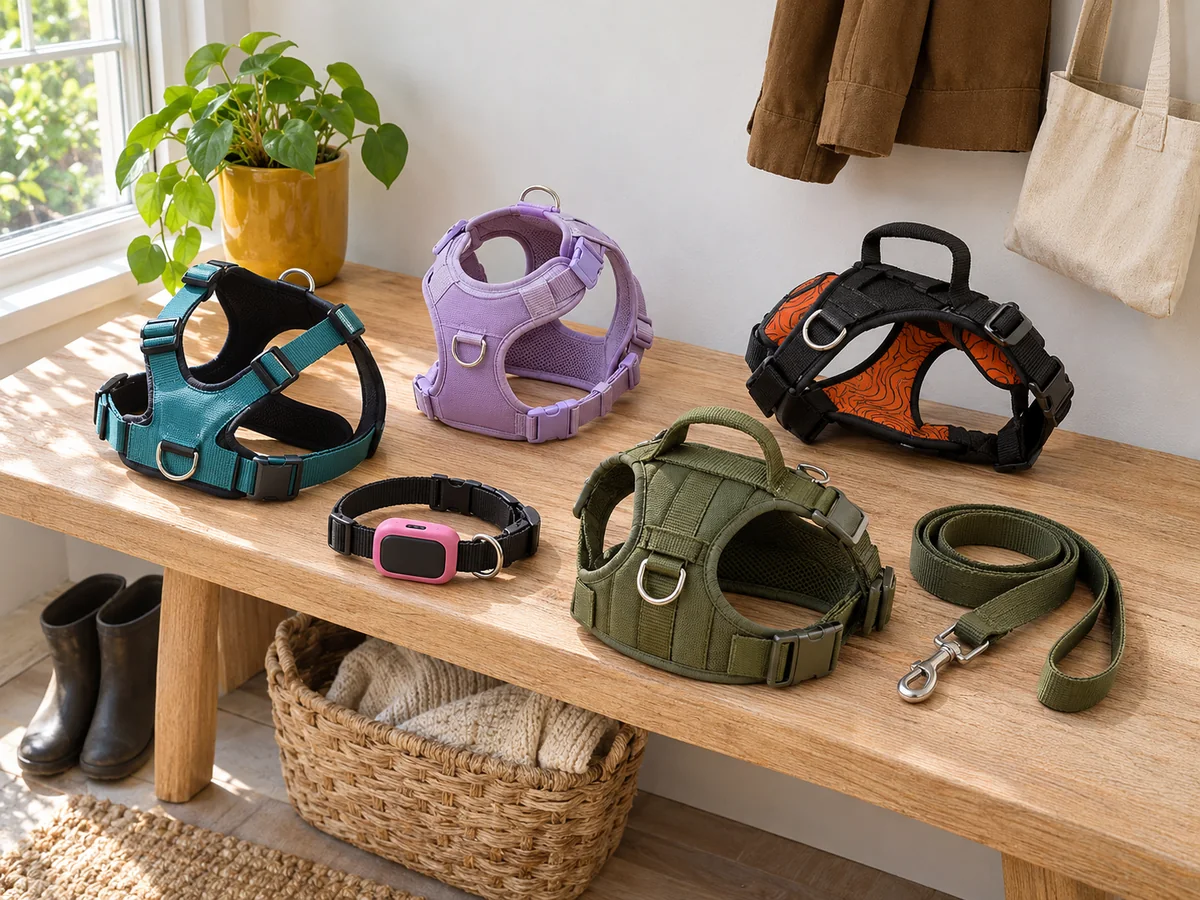
Two rings also allow a third setup, a double-ended leash clipped to both, which gives one hand two points of contact. None of the sources we cite covers that setup; take it as an option, not a recommendation. The 2 Hounds Design Freedom harness in our catalog is sold with a two-clip leash for exactly this. Several harnesses in our Walk and Training picks have both rings, and each pick page says which.
Fit decides whether the clip works
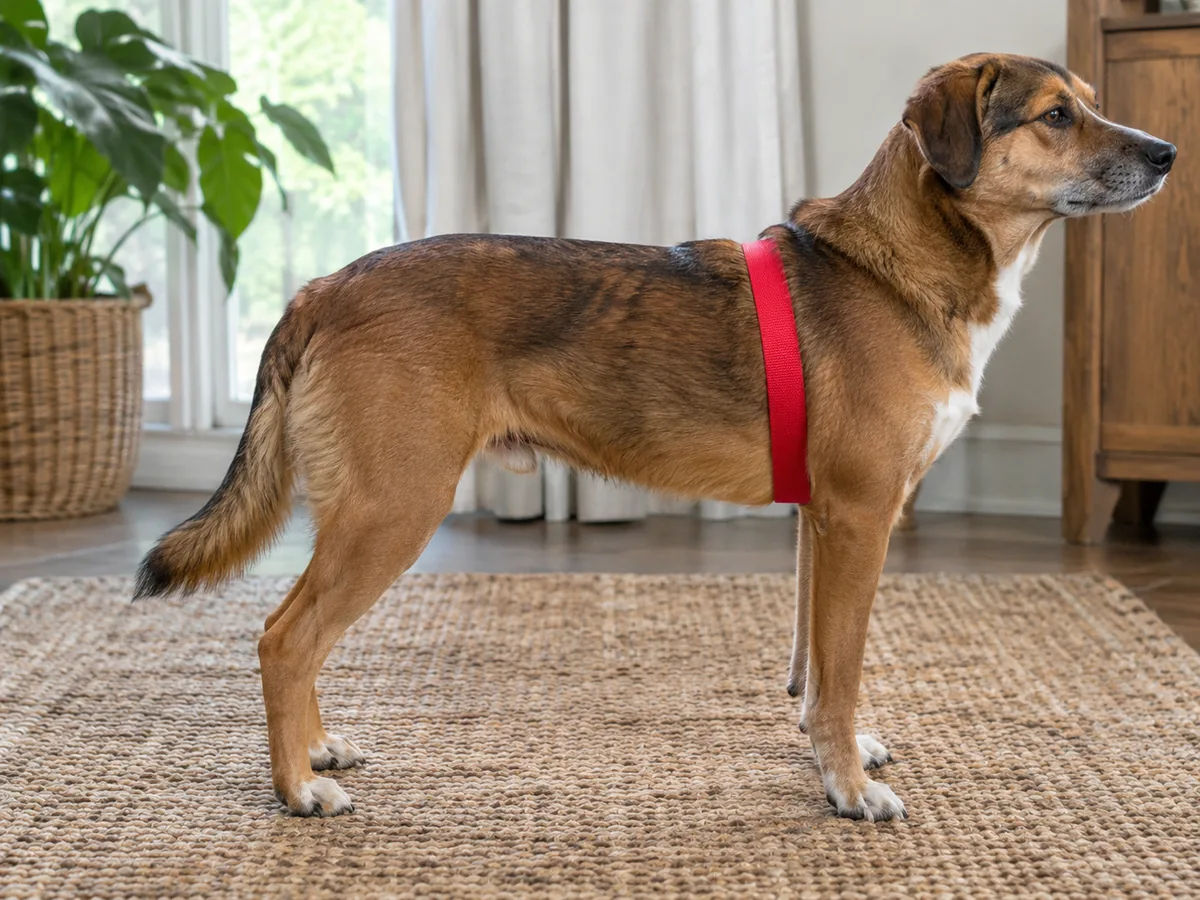
A front ring that has slid down toward the elbows steers nothing, and a loose harness of either kind is one a dog can reverse out of. The AKC’s collar comparison says it of any harness: if it is too big, the dog may be able to wiggle out and escape.
The AKC’s fit check is short, and it applies to both clip positions.
- Snug, but not too tight: you should have to squeeze two fingers under the straps.
- Walk the dog around the house or yard and check that its movement looks natural and unrestricted.
- Gently pull on the harness from different directions to make sure the dog cannot escape.
- Adjust again when the coat, body condition or activity level changes.
Frequently asked questions
Is a front clip or back clip better for a dog that pulls?
Front. The AKC says a front attachment helps redirect a pulling dog’s movement and may discourage pulling, and the veterinarian it quotes recommends back-clip harnesses for well-trained dogs. Pair the front clip with rewards for a loose leash: the harness reduces pulling, it does not train it away.
Can I clip the leash to the front and the back at the same time?
Yes, with a double-ended leash on a harness that has both rings; some dual-clip harnesses are sold with one. None of the sources we cite covers the setup, so this is our reading: it gives you two points of contact with a strong or sudden puller, and it is more hardware than a small or calm dog needs.
Is a back-clip harness OK for a puppy?
Yes, though the AKC’s own pages differ. Its harness guide says harnesses can be especially helpful for puppies, while its collar comparison says that for puppies just learning to walk on a leash it is best to stick with a standard collar. Either way, check the fit often as the puppy grows, and move to a front clip if pulling becomes a habit.
Do front-clip harnesses hurt a dog's shoulders?
A well-fitted one should not limit the front legs. The AKC’s fit advice is to make sure a harness does not interfere with shoulder or leg movement and to watch for rubbing and pressure points, so choose a design that keeps the straps off the joints and adjust it carefully. If the stride looks shorter or the harness rubs behind the elbow, refit it or change it.

Sources
- AKC: Best Dog Harnesses, Types, Fit Tips and Safety Guide
- AKC: Dog Harnesses and Dog Collars, Which Is Right for Your Dog?
- Pauli et al., J Am Anim Hosp Assoc (2006): neck pressure by a collar or harness and intraocular pressure in dogs
- Lafuente et al., Vet Record (2019): restrictive and non-restrictive harnesses and shoulder extension in dogs
Nothing on this site is veterinary advice. Health claims belong to the manufacturer; your vet knows your dog.

By Jack ReyesJack Reyes writes and edits the guides and picks on jackstore.fun, and reads the fine print on dog gear so you do not have to: how a thing works, who it is for and who should skip it. Jack Reyes does not test products and never quotes prices. The other Jack, the Maltipoo on our logo, is the site mascot.