Jack Store blog · Walk & Training
How to Measure Your Dog for a Harness (Size Chart and the Two-Finger Rule)
Last updated:
As an Amazon Associate we earn from qualifying purchases.
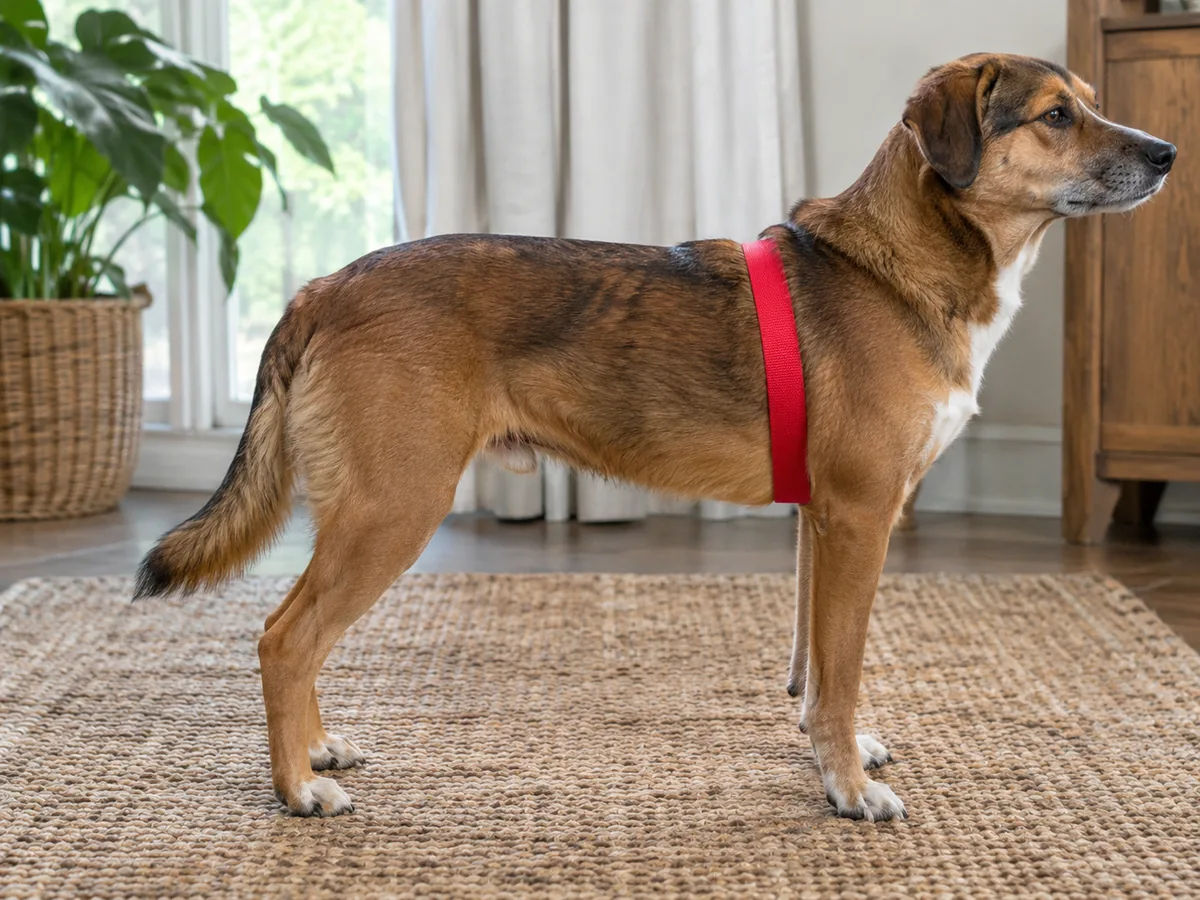
Knowing how to measure a dog for a harness comes down to one number: chest girth, the distance around the widest part of the rib cage, usually just behind the front legs. Measure with the dog standing, keep the tape snug but not tight, and add the neck measurement if the brand asks for it. Weight is a cross-check, not a size.
Then read that number against the chart for the exact harness you are buying, because the same dog can be a Small in one brand and a Medium in another. Below: the three measurements, the step-by-step, two official size charts side by side, what to do between sizes, and the two-finger rule for checking the fit once the harness is on.
In this guide
- The three measurements: girth, neck and weight
- How to measure chest girth, step by step
- How to measure the neck for a harness
- Where weight fits in, and why it cannot pick the size
- Dog harness size chart: why a Medium is not a Medium
- Between two sizes: size up or down?
- The two-finger rule, and where it bends
- The fit checklist: six checks before the first walk
- The honest catch
- Frequently asked questions
The three measurements: girth, neck and weight
Harness charts ask for some combination of three numbers. The American Kennel Club’s measuring guide names chest girth and neck girth as the most important for finding the right harness size. Weight appears on some charts as a rough guide, and a few brands add a fourth number, chest width.
Back length, the third measurement the AKC lists for dog clothing, is for coats and sweaters. For a harness you can skip it.
| Measurement | Where to take it | What it decides |
|---|---|---|
| Chest girth | Around the widest part of the rib cage, usually just behind the front legs | The size. The AKC calls it typically the most important measurement for harnesses |
| Neck | Around the base of the neck, where it meets the shoulders | Whether the neck opening or neck strap fits |
| Weight | A scale, or the number from the last vet visit | A cross-check only. PetSafe says weight ranges are only approximate |
| Chest width (some brands) | Across the front of the chest, from about 1 inch behind one front leg to about 1 inch behind the other | The chest strap, on harnesses such as the PetSafe Easy Walk |
How to measure chest girth, step by step
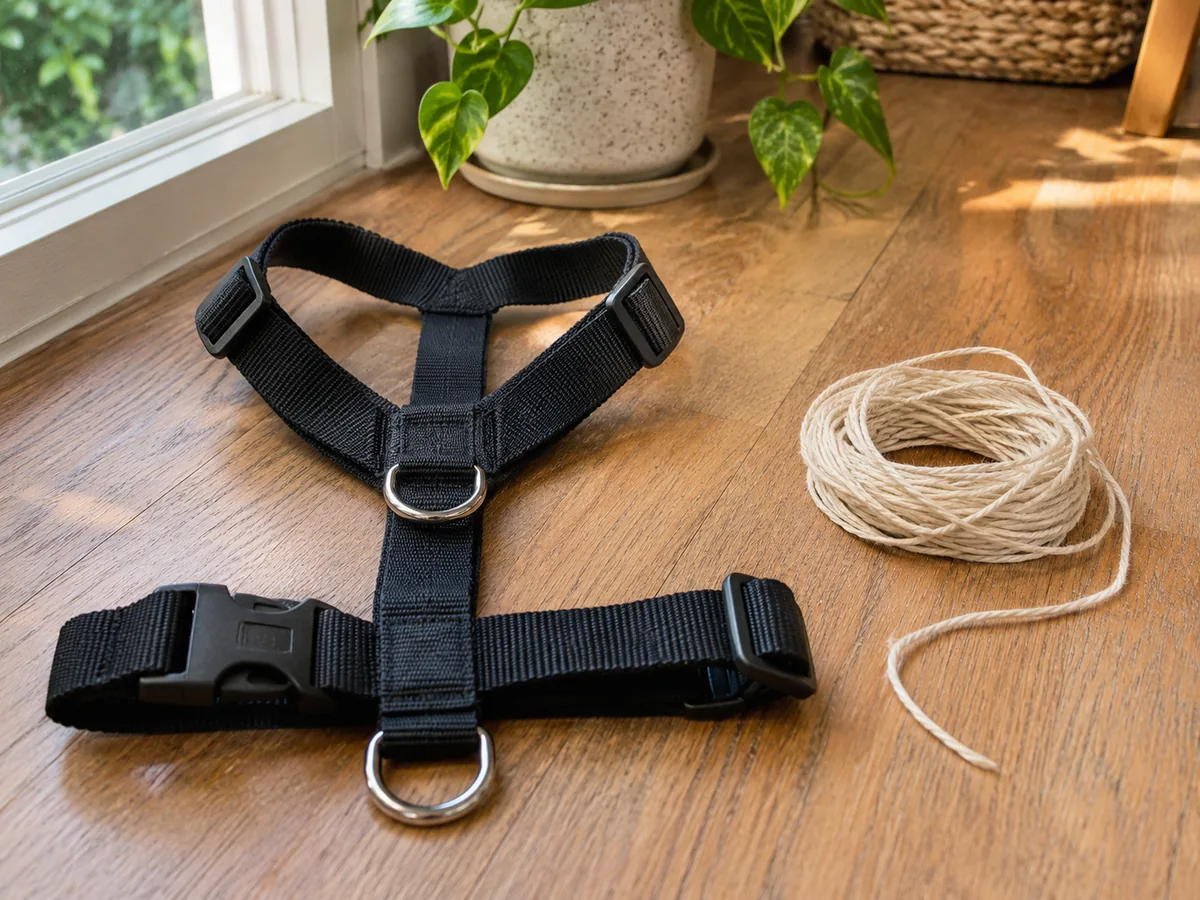
Girth is the measurement that sizes the harness, so it is the one to get right. You need a soft cloth tape, a flat floor and two minutes. No cloth tape? The AKC suggests string, ribbon or a shoelace: wrap it, pinch or mark where it overlaps, then lay it flat against a ruler. PetSafe’s version of the same trick uses the leash you already own.
The steps below follow the AKC’s method. If the brand’s own instructions differ, the brand wins for that harness: PetSafe, for one, asks for the tape tight to the body on its chest-width measurement. And a wriggly dog measures better after a walk than before one.
- Stand the dog on a flat floor. The AKC advises measuring a standing dog, with the weight evenly distributed.
- Find the widest part of the rib cage. It is usually just behind the front legs.
- Wrap the tape all the way around at that point, flat against the coat and not twisted.
- Keep it snug but not tight, and slip two fingers between the tape and the dog. That is the AKC’s way of building breathing room into the number.
- Read the number, then measure once more. If the two readings differ, measure a third time.
- Write it down in inches and in centimeters. Some charts use one, some the other.
How to measure the neck for a harness
For a harness, the AKC’s fit guide asks for the circumference at the base of the neck, where it meets the shoulders. That is where a harness’s neck opening rests. Its measuring guide describes the path: start near the withers, the ridge between the shoulder blades, and wrap the tape around to the front of the chest. Keep the same two fingers under the tape.
The neck number matters most on harnesses that slide over the head, and on dogs built out of proportion: a thick neck over a narrow chest, or the reverse. For those dogs, look for a neck strap that adjusts or opens with a buckle. The Blue-9 Balance in our catalog has six points of adjustment, the neck included.
Where weight fits in, and why it cannot pick the size
Weight is the number every owner already knows, and the one to trust least. PetSafe says so on the Easy Walk size chart itself: measuring your dog is the most accurate way to determine harness size, and weight ranges are only approximate.
The same chart shows why. Its Medium is listed for 25-50 lbs. and its Medium/Large for 40-65 lbs., so a 45-pound dog sits in both. Girth breaks the tie.
Use weight in one direction only, as a sanity check. If the girth says Small and the weight column says Large, measure again before you order.
Dog harness size chart: why a Medium is not a Medium
There is no standard harness size chart, only each brand’s own. The table below reads two official ones side by side. Ruffwear sizes its harnesses by girth alone. PetSafe sizes the Easy Walk by girth plus chest width. The numbers are each brand’s own, copied from the pages linked in the sources, and they apply to those harnesses and no others.
A dog with a 24-inch girth is a Small at Ruffwear. On the PetSafe chart the same dog falls inside three overlapping sizes: Small/Medium (19 to 26 in), Medium (22 to 32 in) and Medium/Large (24 to 34 in), which is why that chart also asks for chest width. Both brands make sizes beyond the four rows below; Ruffwear’s chart goes down to XXXS at 9 to 13 in.
For any other harness, including every one sold through an Amazon listing, use the chart on that listing. The Ruffwear Front Range and the PetSafe models in our catalog are no exception. Still choosing? Our no-pull harness guide has the harnesses we would pick, and front-clip vs back-clip harness covers which ring you need.
| Size on the label | Ruffwear harnesses (girth) | PetSafe Easy Walk (girth) |
|---|---|---|
| Small | 22 to 27 in | 15 to 21 in |
| Medium | 27 to 32 in | 22 to 32 in |
| Large | 32 to 36 in | 27 to 40 in |
| Extra Large | 36 to 42 in | 32 to 49 in |
Between two sizes: size up or down?
Up, according to all three sources that address it. The AKC’s measuring guide says to opt for the larger size when in doubt, because a slightly looser fit is better than one that constricts. PetSafe says to choose the larger size, or the size in which the girth measurement best matches. Ruffwear says a growing puppy that is truly between two sizes should get the larger one.
The condition is that the larger size still tightens down to your dog’s number. Too big is its own problem: the AKC warns that a dog may be able to wiggle out of a harness that is too big and escape, and Ruffwear notes that gear that is too large or too small can chafe or slip. Check the low end of the larger size’s range before you choose it, and favor adjustable designs, which is the AKC’s advice for dogs that fall between sizes.
Puppies: size for today. Ruffwear recommends sizing on the puppy’s current measurements, and the AKC says to regularly adjust the fit or replace the harness as a puppy grows.
The two-finger rule, and where it bends
Once the harness is on, the classic check is two fingers: you should be able to slide two fingers between any strap and the dog. Tighter than that pinches. Looser, and the harness shifts, rubs or comes off over the head. For a dog that has already backed out of one, a three-strap design such as the Huntboo escape-proof harness in our catalog adds a strap behind the ribs.
The rule has two refinements worth knowing. The first is size. The AKC’s harness and collar guide says a harness fits if you can slip one finger under it on small dogs and two fingers on large-breed dogs. Two adult fingers under the strap of a toy breed is a loose harness.
The second is snugness. Dr. Amy Attas, the veterinarian quoted in the AKC’s fit guide, thinks the usual two-finger gap might be just slightly too much; in her words, you should have to squeeze two fingers underneath, but not so tight that it is uncomfortable. The same guide adds that dogs with thick or fluffy coats may require slightly tighter adjustments to prevent slipping, so press the strap down through the coat before you judge the gap.
The fit checklist: six checks before the first walk
The measurement gets the right size to your door. These six checks tell you whether it fits the dog in front of you.
- Fingers: one under each strap on a small dog, two on a large one, snug enough that you have to squeeze them in.
- Shoulders: the front legs swing freely. The AKC says a harness should not interfere with shoulder or leg movement.
- Behind the front legs: no strap digging in. Look for rubbed fur after the first walks.
- Escape check: gently pull on the harness from different directions, forward over the head included, to make sure the dog cannot get out.
- House lap: walk the dog around the house or yard and watch for natural, unrestricted movement.
- Recheck: a harness that fits today may need adjusting when the coat, body condition or activity level changes.
Frequently asked questions
Where do you measure a dog's girth for a harness?
Around the widest part of the rib cage, which is usually just behind the front legs. Measure with the dog standing, the tape snug but not tight, and two fingers between the tape and the dog, as the AKC advises. Girth is the main number on a harness size chart.
What if my dog is between two harness sizes?
Choose the larger size, as the AKC, PetSafe and Ruffwear all advise, provided its smallest setting still reaches your dog’s girth. Then tighten the straps to fit. A harness that is too big lets a dog wiggle out, so check the low end of the larger size’s range before you order.
How tight should a dog harness be?
Snug, with room for two fingers under each strap on a large dog and one finger on a small dog, per the AKC. You should have to squeeze the fingers in. Then check that the front legs move freely and that the dog cannot back out when you gently pull the harness forward.
Can I choose a harness size by weight?
Not reliably. PetSafe says on its own chart that weight ranges are only approximate and that measuring your dog is the most accurate way to determine harness size. On that chart a 45-pound dog falls in two sizes at once. Use weight to double-check the girth, never to replace it.

Sources
- AKC: The Ultimate Dog Apparel Measuring Guide
- AKC: Best Dog Harnesses, Types, Fit Tips and Safety Guide
- AKC: Dog Harnesses and Dog Collars, Which Is Right for Your Dog?
- Ruffwear: The Size Is Right, How to Measure for Your Dog's Gear
- PetSafe: Easy Walk Harness sizing chart
- PetSafe Support: How to Measure Your Dog for an Easy Walk Harness
Nothing on this site is veterinary advice. Health claims belong to the manufacturer; your vet knows your dog.

By Jack ReyesJack Reyes writes and edits the guides and picks on jackstore.fun, and reads the fine print on dog gear so you do not have to: how a thing works, who it is for and who should skip it. Jack Reyes does not test products and never quotes prices. The other Jack, the Maltipoo on our logo, is the site mascot.